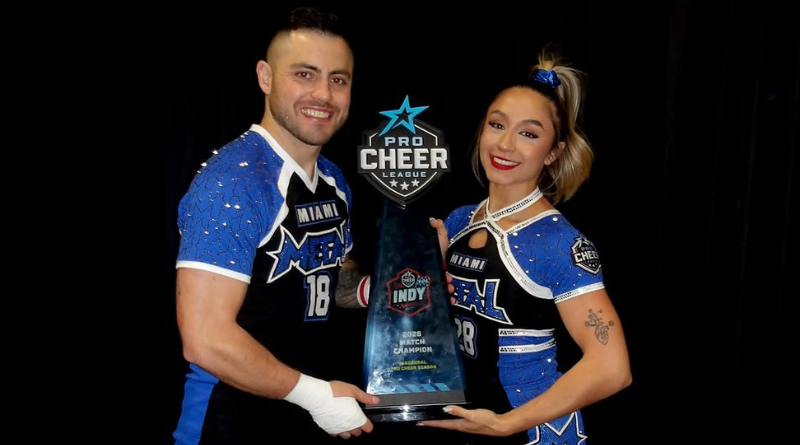
Professional cheerleading officially arrived Thursday night as Miami Metal captured the Pro Cheer League’s inaugural championship by a single point over Dallas Drive at the Indiana Convention Center.
Written By Chelsie Hollencamp — documenting the Pro Cheer League’s inaugural season. Image via @gymtime.cl
The historic evening, broadcast live on ION to a national audience, featured 96 founding athletes across four teams competing in a format that blended traditional cheerleading skills with standalone challenges designed to showcase athleticism, strategy, and mental toughness under pressure.
The Final Standings
- Miami Metal: 13 points (Champions)
- Dallas Drive: 12 points
- Golden State Grit: 9 points
- Atlanta Air: 6 points
See current League Standings here.
Metal’s one-point margin of victory came down to the final competition—a highest tumbling challenge where Miami’s Kory Little posted a measured height of 7’3″, securing the title for the South Florida squad.
“Last night felt like a full-circle moment,” said Miami Metal’s Javon “Jay” Kendrick after the match. “Years of grinding in the shadows, finally getting to step into the light as a pro. It wasn’t just a debut—it felt like history.”
The evening’s four-quarter format tested teams across multiple disciplines rather than a single two-and-a-half-minute routine. Each quarter awarded points to teams based on head-to-head competition results.
FOR ONGOING PRO CHEER LEAGUE NEWS, MATCH UPDATES & FEATURES, SUBSCRIBE TO OUR FREE BI-WEEKLY NEWSLETTER:
Quarter 1: Creative Routines
Teams performed choreographed routines set to music, judged on creativity, athleticism, and showmanship. Specific scores have not been publicly released, but all four teams showcased the elite-level skill that earned them spots in the league’s inaugural season.
Quarter 2: Battle Games
Hangtime (Basket Tosses Height Challenge): Miami Metal and Dallas Drive both won their respective matches, demonstrating the explosive power and precision timing required at the professional level.
Coed Endurance (One-Arm High-to-High): Atlanta Air outlasted Golden State Grit 33-27 in a grueling test of strength and stamina. Air’s Jordan “JT” Taylor and Autumn Schless employed a rapid-switch strategy—alternating between dominant and non-dominant hands—that proved successful despite added technical difficulty.
Flash Pyramid (A high energy blend of teamwork and skill): Miami Metal and Dallas Drive faced off in a best-of-five race to build pyramids based on silhouettes shown on screen. Drive took the competition 3-2, with captain Anuhea Keene topping the final A-frame structure with championship-level precision.
Quarter 2 scores:
- Drive 4 points
- Metal 3 points
- Air 2 points
- Grit 1 point
Quarter 3: Battle Games
Last Pass: Teams deployed four athletes each—one soloist plus a synchronized trio—in a competition judged on precision, technique, skill, synchronization, and style.
Atlanta Air’s Devonte “Dee” Joseph delivered the quarter’s most jaw-dropping moment: a tumbling sequence culminating in a triple twisting full that brought the crowd to its feet. Despite the superior difficulty, judges awarded the round to Golden State Grit based on cleaner execution and synchronization.
Miami Metal advanced to the Winners Bracket after Skylar Graves‘ solo performance—a roundoff back-handspring double layout stuck so precisely he turned to the crowd decisively, arms raised. “That’s exactly what I was thinking,” Graves confirmed with me post-match, referencing the “are you not entertained” moment.
The quarter also featured a first: Atlanta Air deployed Seneka Erickson as the first female athlete in the Last Pass competition, breaking gender barriers in the league’s debut match.
All-Girl Endurance (Traditional High to High with Heel Stretch) Atlanta Air and Dallas Drive participated in the traditional, all-girl version of this game, which had one major variation from its coed counterpart—the top girl needed to immediately hit a heel stretch on each pop or tick tock.
Dallas Drive had a last-minute substitution, bringing in Tatiyahna Davis as their top girl, along with Angelina Portugal, Sarah Cross, and Kendall Rabick. The team posted an impressive 26 tick tocks with a consistent, almost rhythmic pace.
When Atlanta took the mat with Kariss Humphries, Alex Simonis, Jada Thompson, and Jaya Hardy—they followed the same strategy that brought their Coed team the victory in quarter two. With quick pops to the non-dominant side, followed by a longer breath on Kariss’ dominant stretch leg—the group was able to take home the win here as well with a total of 32 switches.
Bullseye (Tumbling Variation and Precision) Athletes perform tumbling passes that must land inside a designated target zone on the mat, with no repeated skills allowed and at least two rotational elements required. Points are awarded based on difficulty, but landing outside the target results in a zero—Miami Metal’s Felipe Bastias learned this the hard way in Indianapolis when his “punch-two to double” drifted right and scored a zero despite high difficulty.
Golden State Grit won the round through consistency, with Kenzie “Squirrel” Carothers anchoring a 70-point pass while Miami’s Liam Potolsky closed with swagger and a triple for 70 points, proving precision matters more than power.
Quarter 3 scores:
- Grit 4 points
- Metal 3 points
- Air 2 points
- Drive 1 point
Quarter 4: Battle Games
All-Girl Big Trick Female athletes perform one elite stunt sequence, demonstrating advanced transitions, releases, and creativity. In Indianapolis, Miami Metal delivered a masterclass: a 1.25-twist rewind to a cupie, transitioning to a full-around at the top into a lib, and finishing with a press kick double dismount—elite transitions that advanced Miami to the winners bracket along with Dallas Drive, leaving Atlanta Air and Golden State Grit in the final losers bracket of the night.
Coed Big Trick Mixed-gender duos perform an elite stunt sequence to push for the best overall presentation, considering both difficulty and technique. Atlanta Air brought Autumn Schless and Jordan “JT” Taylor, executing a powerful sequence that showcased their coed endurance chemistry.
Meanwhile, Golden State Grit deployed Kevin-Anthony “Nemo” Zelaya and Talya Carrescia for a unique sequence including a twisting swing-through cannonball up to extended handstand, arabesque, with a unique ball transition, inverting to pop through to the top, with a half spin release and combined flip with twist dismount—taking the win in this round.
The Highest Tumbling finale determined the championship. Kory Little’s 7’3″ measured height—a testament to explosive leg power combined with rotational control—secured the title for Miami Metal by that single point over Dallas Drive.
Quarter 4 scores:
- Metal 4 points
- Drive 3 points
- Grit 2 points
- Air 1 point
Standout Moments
Skylar Graves‘ Championship Confidence – Beyond the technical brilliance of his stuck double layout, Graves revealed post-match that Miami Metal “only really had one full-team practice before this match.” His immediate follow-up: “Just wait until we get more time together this season. Something you can look forward to is nothing but improvement.” That combination of elite performance and championship swagger set the tone for what professional cheerleading can be.
The Captains’ Composure – Dallas Drive captains James Thomas and Madison Hayes—both Team USA veterans—demonstrated championship resilience throughout the evening. After losing Flash Pyramid’s Round 3, they swept Rounds 4 and 5 to take the competition. That mental toughness kept Drive within one point of the title despite falling short in the final tumbling challenge.
Golden State Grit’s Team Spirit – Athletes Ashlie Modabber and Tessa Grimm captured something beyond competition: “The game and the whole first event was amazing and game-changing, history-making, and we are so happy to be a part of something so big. All the teams coming together was super fun. We loved the environment of having all four teams come together.”
That founding cohort mentality—competing intensely while celebrating the collective achievement—defined the evening’s atmosphere.
Atlanta Air’s Technical Excellence – Despite finishing fourth, Air brought arguably the highest difficulty in the building. Devonte Joseph’s triple twisting full and the team’s innovative endurance strategy showed that sometimes execution beats difficulty in professional sport—but the talent foundation is undeniable.
Why This Match Mattered
For Cheerleading: This was the moment the sport officially professionalized. Athletes who have spent careers perfecting skills that rival Olympic gymnastics finally competed with “professional” in front of their names, broadcast nationally, with compensation for their athleticism.
For The Athletes: All 96 founding athletes made history simply by showing up. Whether they competed in every quarter or served as strategic reserves, they’re the cohort that proved professional cheerleading can exist. Their names will be in the record books as the first.
For The Sport’s Future: The format—standalone skills rather than single routines—opens new strategic possibilities. Roster depth matters. Specialized athletes can shine. Coaches make tactical decisions about deployment rather than just showcasing their best 20 in one performance.
For Fans: Cheerleading has been an elite sport trapped in an amateur structure for decades. This match proved there’s an audience for professional competition when athletes are celebrated as the world-class performers they are.
What’s Next
The Pro Cheer League continues its five-match inaugural season with:
- Match 2: Atlanta, February 13 (CHEERSPORT Nationals)
- Match 3: Houston, February 27 (NCA All-Star Nationals)
- Match 4: Anaheim, March 13 (USA All Star Super Nationals)
- Championship: Nashville, March 27 (One Up Grand Nationals)
Miami Metal holds the early lead, but with four matches remaining and only a one-point margin separating first from second, the founding season championship is wide open.
Dallas Drive will be looking for redemption. Golden State Grit showed they can win against elite competition. Atlanta Air has the raw talent to climb the standings if execution matches difficulty.
The founding night in Indianapolis proved that professional cheerleading can exist. The broadcast production on ION was seamless, the specialized format made the scoring accessible, and the athletes—though still learning their teammates’ names—performed at a level that justified the “Pro” label.
What’s missing is the connective tissue—the independent franchise ownership and the transparent athlete representation. But for one night in January, none of that mattered. What mattered was the sound of the mat when Skylar Graves stuck his landing, and the silence of the crowd after Dee Joseph’s triple twisting full that pushed the boundaries of what’s possible.
The PCL has found its floor. Now, it has to prove it can sustain the flight.
Chelsie Hollencamp is documenting the Pro Cheer League’s inaugural season with embedded athlete access and nearly a decade of competitive cheerleading expertise. Follow Founding Season’s coverage of professional cheerleading’s first year at foundingseasonpcl.substack.com for in-depth athlete profiles, technical analysis, and honest reporting on what it means to be a founding professional cheerleader.